
Uniform Civil Code — Latest Developments
From Directive Principle to Ground Reality
Article 44 of the Constitution of India directs the State to endeavour to secure for citizens a uniform civil code throughout the territory of India. For over seven decades, this remained a Directive Principle — aspirational, debated, and politically contested. In 2025 and 2026, that changed.
What is the UCC?
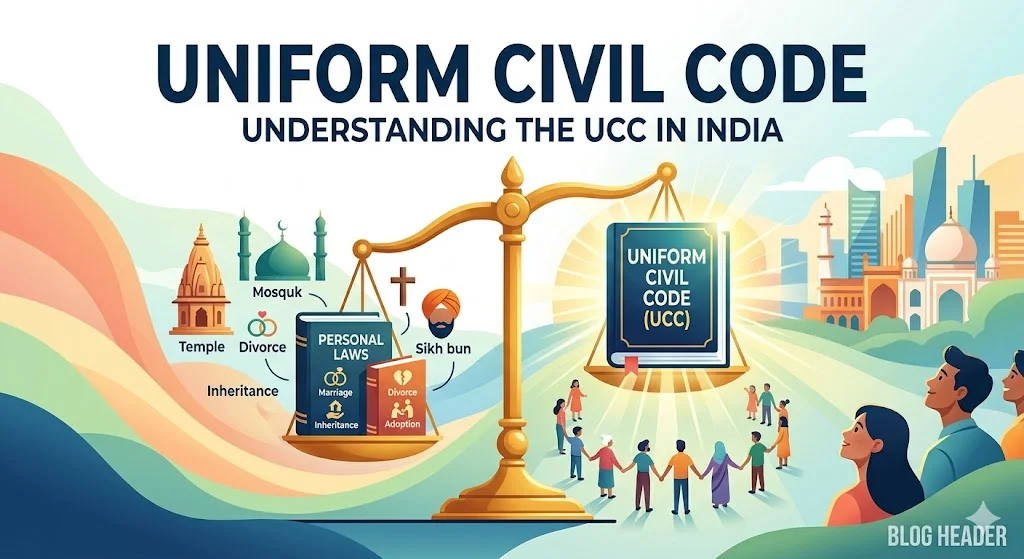
A Uniform Civil Code would replace religion-specific personal laws — governing marriage, divorce, inheritance, adoption, and succession — with a single civil code applicable to all citizens regardless of religious community. Currently, Hindus are governed by the Hindu Marriage Act and Hindu Succession Act; Muslims by Muslim Personal Law; Christians by the Indian Christian Marriage Act; and Parsis by the Parsi Marriage and Divorce Act. A UCC would unify all these into one secular framework.
Uttarakhand: India's First State UCC
Uttarakhand became the first state in independent India to implement the Uniform Civil Code. The UCC came into force in the state on January 27, 2025. The UCC seeks to establish a uniform and equal set of rules on marriage, divorce, succession, and inheritance for all citizens in the state, except the scheduled tribes, irrespective of religion. It makes registration of all marriages and live-in relationships mandatory. DD News
The UCC has reshaped Uttarakhand's civil law framework by simplifying and digitising processes related to marriage, divorce, and live-in relationships, making systems far more accessible for ordinary citizens. GKToday
Key Provisions of Uttarakhand's UCC
Under the Act, marriages can only be solemnised between individuals who meet specific legal criteria — both parties must be mentally competent, must have reached the legal age (21 years for men and 18 for women), and must not have a living spouse at the time of marriage. All marriages and live-in relationships must be mandatorily registered within a prescribed timeframe. Failure to register attracts penalties.
The UCC provides uniform rules for inheritance, making equal provision for sons and daughters regardless of religion. It also streamlines divorce procedures and provides for a common framework for maintenance.
The UCC Amendment Ordinance, 2026
Uttarakhand implemented the Uniform Civil Code (Amendment) Ordinance, 2026, which came into effect immediately on January 26, 2026, after receiving the assent of the Governor. This ordinance introduces approximately 15 amendments to the original UCC Act of 2024. Muslim Mirror
After one year of implementation, the 2026 Amendment Ordinance seeks to address procedural gaps, legal inconsistencies, and enforcement challenges. The ordinance introduces nearly 18 major amendments to the original 2024 UCC Act, focusing on legal clarity, administrative efficiency, and stronger penalties. The Prayas India
Notable among the amendments: if a person conceals their identity at the time of marriage, it is now a valid legal ground for annulment through courts, helping prevent fraud marriages. The term "widow" has been replaced with "spouse" in legal schedules to promote gender-neutral language. References to old criminal laws have been updated to align with BNS, BNSS, and BSA.
Gujarat Becomes the Second State
The Gujarat Legislative Assembly on March 24, 2026, passed the Gujarat Uniform Civil Code Bill, 2026, with a majority vote, marking a decisive step towards implementing a common civil framework in the state. With this, Gujarat joins Uttarakhand as the second state in India to enact such a law aimed at unifying personal laws across religions. Organiser Weekly
Assam Enters the Picture
The Government of Assam introduced the Uniform Civil Code Bill, 2026, in the State Legislative Assembly, positioning Assam as the third BJP-ruled state after Uttarakhand and Gujarat to formally introduce UCC legislation. The Assam bill provides exemptions for Scheduled Tribes, ensuring protection of traditional customs and cultural practices — a pattern that is emerging as a standard carve-out across state-level UCC frameworks. Edunovations
The Constitutional Questions
The UCC remains contested on multiple constitutional grounds. Article 25 guarantees freedom of religion, including the right to manage religious affairs. Critics argue that personal laws derived from religious scripture form part of religious practice protected under Article 25. Proponents counter that Article 44 specifically contemplates uniformity, and that the Supreme Court has in multiple cases — Shah Bano (1985), Sarla Mudgal (1995), and Shayara Bano (2017) — called for legislative action on personal law reform.
The UCC as currently enacted in Uttarakhand excludes Scheduled Tribes — a constitutional necessity given the Fifth and Sixth Schedule protections for tribal customary law. Whether this exemption is sufficient or raises its own equality concerns is an open legal debate.
No UCC is implemented nationwide yet, though Uttarakhand has taken steps toward implementation and other states are actively discussing it. Edunovations
Key Provisions: Article 44 DPSP · Uttarakhand UCC Act 2024 · UCC Amendment Ordinance 2026 · Gujarat UCC Bill 2026