
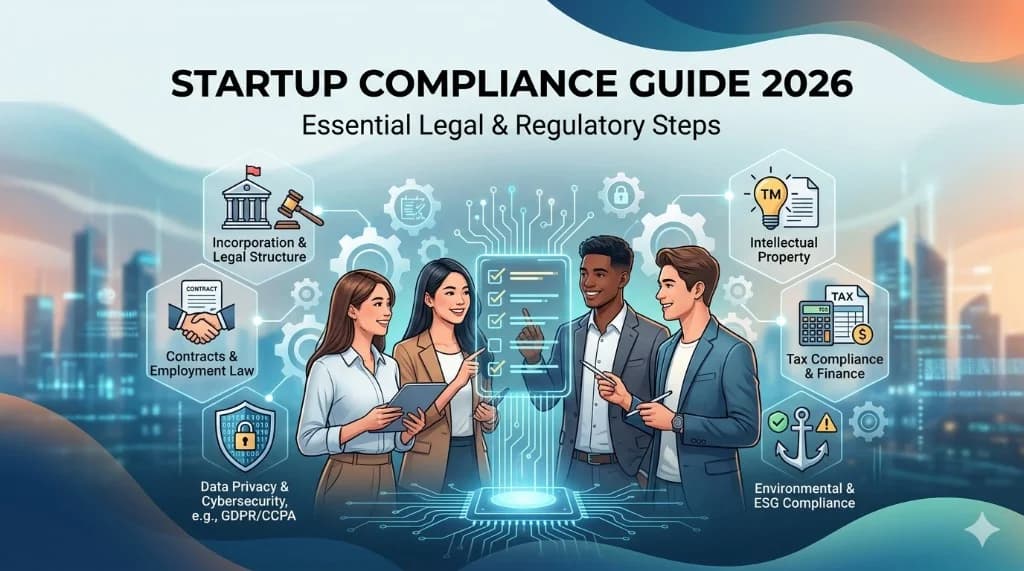
Startup Compliance Guide 2026
What Every Indian Startup Founder Must Know About Legal Compliance in 2026
Startups often think of compliance as something that matters only once investors arrive, revenue grows, or the finance team becomes larger. That approach is risky. Missed filings attract automatic penalties, director disqualifications, and — in serious cases — criminal liability. This guide covers everything a founder needs to know from day one.
Step 1: Choose Your Business Structure
Startups must choose from three primary business structures: Private Limited Company, Limited Liability Partnership (LLP), or One Person Company (OPC).
A Private Limited Company is the most suitable structure for startups seeking external funding, as it allows equity issuance, has a clear share structure, and is the form recognised by DPIIT for Startup India recognition. An LLP is simpler and less compliance-intensive, suitable for professional service firms and co-founders who want pass-through taxation. An OPC suits solo founders with limited liability, though it cannot take external investment easily.
Step 2: Incorporate via SPICe+
All companies must register online with the Ministry of Corporate Affairs via the SPICe+ Form. Essential documents required include PAN card, Aadhaar, proof of address, and a unique business name.
The SPICe+ form integrates company incorporation, PAN, TAN, GST registration, and ESIC/EPF registration into a single application — dramatically reducing the time and cost of incorporation.
Step 3: Startup India Recognition (DPIIT)
DPIIT recognition under the Startup India initiative provides substantial benefits: 3 years' income tax exemption under Section 80-IAC, exemption from angel tax under Section 56(2)(viib), self-certification under labour and environment laws, fast-track patent examination, and access to the government's Fund of Funds. To qualify, the startup must be less than 10 years old, have annual turnover not exceeding ₹100 crore, and be working towards innovation, development, or improvement of products or services.
Step 4: Mandatory Registrations
GST Registration
GST registration and compliance requirements apply to most startups exceeding the turnover threshold of ₹20 lakhs (₹10 lakhs for special category states). Service-based startups and e-commerce businesses must register regardless of turnover.
Post-registration compliance includes filing monthly GSTR-1 (outward supplies), GSTR-3B (summary returns), and annual GSTR-9 returns. Maintaining proper invoice formats, collecting GST from customers, and reconciling input tax credit claims require systematic processes.
PAN and TAN
PAN is required for all tax filings. TAN (Tax Deduction and Collection Account Number) is mandatory for deducting and remitting TDS (Tax Deducted at Source) — applicable from the first salary payment or vendor payment above the threshold.
Labour Law Registrations
Labour laws applicable include the Employees' Provident Fund Act, Employees' State Insurance Act, and the Shops and Establishments Act, depending on your team size and location. EPF registration is mandatory once you have 20 or more employees; ESIC applies at 10 employees in most states.
Step 5: Annual Compliance Calendar
The annual compliance checklist for startups in India for FY 2026-27 spans ROC filings, GST returns, income tax, TDS, and HR obligations, each with separate deadlines, forms, and penalties.
Critical dates for a Private Limited Company:
- Board meetings must be held at least 4 times per year, with no gap exceeding 120 days between two consecutive meetings.
- The AGM (Annual General Meeting) must be held by September 30 each year.
- AOC-4 (financial statements) must be filed with MCA by October 30.
- MGT-7 (annual return) must be filed by November 29.
- DIR-3 KYC for all directors must be filed by September 30.
- DPT-3 (deposits return) must be filed by June 30.
- GSTR-9 (annual GST return) must be filed by December 31.
Step 6: The DPDP Act — A New Compliance Obligation
Every startup that collects, processes, or stores personal data of users — which includes virtually every digital product or service — is now a Data Fiduciary under the DPDP Act, 2023. Obligations include obtaining proper consent before data collection, providing a clear privacy notice, implementing reasonable security safeguards, reporting data breaches to the Data Protection Board within the prescribed time, and ensuring children's data is handled only with verifiable parental consent.
Step 7: Intellectual Property
Filing trademark applications for your brand name and logo from day one is critical. Unlike many jurisdictions, India operates on a first-to-file basis for trademarks. Patent applications for inventive products or processes should be filed before any public disclosure. DPIIT-recognised startups benefit from an 80% rebate on patent fees and fast-tracked examination.
Common Mistakes Founders Make
Common errors include delaying registrations, ignoring tax filings, poor documentation, not drafting legal agreements, and missing compliance deadlines. A proactive approach to legal compliance ensures long-term stability.
The compliance landscape in 2026 is more interconnected and more automated than at any previous point. The GSTN system matches GSTR-1 data filed by suppliers against GSTR-2B records seen by buyers, and flags mismatches in real time. The MCA monitors annual return filing status and enforces director disqualification automatically under Section 164(2)(a) of the Companies Act, 2013 when companies fail to file for three consecutive years.
Key Statutes: Companies Act 2013 · GST Acts · DPIIT Startup India Scheme · EPF Act · ESIC Act · DPDP Act 2023 · Trademarks Act 1999