
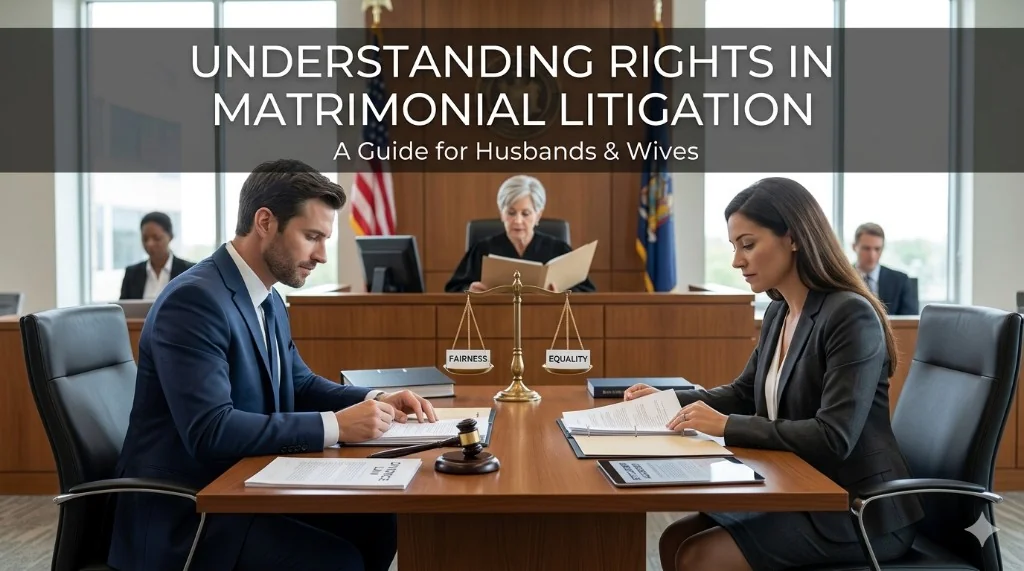
Rights of Husbands and Wives in Matrimonial Litigation
Navigating Matrimonial Litigation in India: What Each Spouse Is Actually Entitled To
Matrimonial litigation in India is among the most emotionally and financially draining legal experiences a person can face. Understanding your legal rights before entering the courtroom — or the family court — can make an enormous difference.
The Legislative Framework
Matrimonial rights in India are governed primarily by: the Hindu Marriage Act, 1955 (HMA) for Hindus, Buddhists, Jains, and Sikhs; the Hindu Adoptions and Maintenance Act, 1956 (HAMA); the Special Marriage Act, 1954 (for civil marriages and inter-religious marriages); the Muslim Personal Law (Shariat) Application Act, 1937; the Indian Christian Marriage Act, 1872; and the Protection of Women from Domestic Violence Act, 2005 (PWDVA). Maintenance during and after criminal proceedings is governed by Section 125 of the BNSS 2023 (which replaced Section 125 CrPC).
Rights of the Wife
Right to Maintenance
Under HAMA, Section 18 guarantees a Hindu wife's right to maintenance, both while living with her husband and under specific circumstances where she lives separately. Grounds include cruelty, neglect, desertion, the husband's conversion to another religion, or if he has a concubine in the marital home.
Under HMA, Sections 24 and 25 provide interim maintenance and permanent alimony respectively. Section 24 ensures financial relief during the pendency of matrimonial proceedings, while Section 25 addresses post-divorce sustenance.
Maintenance Even for Working Wives
A critically important 2025 development: the Bombay High Court held that there was a huge disparity in the income of the husband and wife, which could not be compared, and thus the wife was certainly entitled to be maintained with the same standard of living as she was accustomed to before their separation — even when the wife was employed. SCC Times
The court in that case relied on the Supreme Court's guidelines in Rajnesh v. Neha (2021) and Pravin Kumar Jain v. Anju Jain (2025) which prescribed the factors courts must consider: status of the parties, reasonable needs of the wife and dependent children, qualifications and employment of both parties, independent income of the applicant, standard of living enjoyed in the matrimonial home, and financial capacity of the husband.
Right to Matrimonial Home
Under the PWDVA, a woman in a domestic relationship has a right of residence in the shared household, regardless of ownership. She cannot be evicted from her matrimonial home without due process, even if the home is owned by the in-laws.
Right Against Domestic Violence
The PWDVA provides for protection orders, residence orders, monetary relief, custody orders, and compensation orders. These can be obtained quickly on an ex parte basis in cases of immediate danger.
Rights of the Husband
Right to Contest Maintenance
A husband can contest a maintenance application by demonstrating his wife's independent income and financial capacity. Courts have consistently held that mere employment does not disentitle a wife to maintenance if there is significant income disparity, but persistent concealment of income by the wife is a valid ground to reduce or deny maintenance.
Right to Seek Divorce
Under Section 13 of HMA, either spouse can petition for divorce on grounds including cruelty, desertion for two or more years, conversion to another religion, unsoundness of mind, venereal disease, renunciation of the world, or when the other spouse is not heard of for seven years. Adultery was decriminalised as an offence by the Supreme Court in Joseph Shine v. Union of India (2018) but remains a ground for divorce under HMA.
Right to Maintenance for Husband
Section 25 of HMA states that either spouse can file for permanent maintenance and alimony after the passing of any decree. Courts have in several instances granted maintenance to husbands where the wife's income substantially exceeded the husband's and the husband demonstrated genuine need. Jus Corpus
Right to Custody
Custody of children under five is usually awarded to the mother. However, this is not a rigid rule; both parents are equally eligible to seek custody, with the primary consideration being the child's welfare. Jus Corpus
Right Against False Complaints
The misuse of Section 498A IPC (now BNS Section 85 — cruelty by husband or his relatives) has been judicially acknowledged. The Supreme Court in Rajesh Sharma v. State of UP (2017) issued guidelines to prevent arrest without inquiry, though these were later modified. A husband falsely accused has the right to seek anticipatory bail, to apply for quashing of proceedings under Section 528 BNSS (formerly Section 482 CrPC), and to pursue perjury proceedings if false evidence is shown.
Maintenance: How Courts Compute It
The Supreme Court in Rajnesh v. Neha (2021) laid down comprehensive guidelines: both parties must file an affidavit of assets, liabilities, and income; courts must ensure no duplicate maintenance orders operate simultaneously; and maintenance should be calculated to ensure the claimant's reasonable living needs are met without causing undue hardship to the payer.
The judgment in a 2025 Delhi High Court case is an illustration of how Indian matrimonial law still insists on fault, condonation, and clean hands even while it protects a spouse's economic rights. MarketScreener
Restitution of Conjugal Rights
Section 9 of the HMA provides that either spouse may petition the Family Court for restitution of conjugal rights if the other has withdrawn from the society of the petitioner without reasonable cause. A decree for restitution does not force physical cohabitation but is relevant in subsequent divorce and maintenance proceedings. The Supreme Court's constitutional challenge to Section 9 remains pending.
Key Statutes: HMA 1955 · HAMA 1956 · PWDVA 2005 · BNSS 2023 (Section 125) · Special Marriage Act 1954