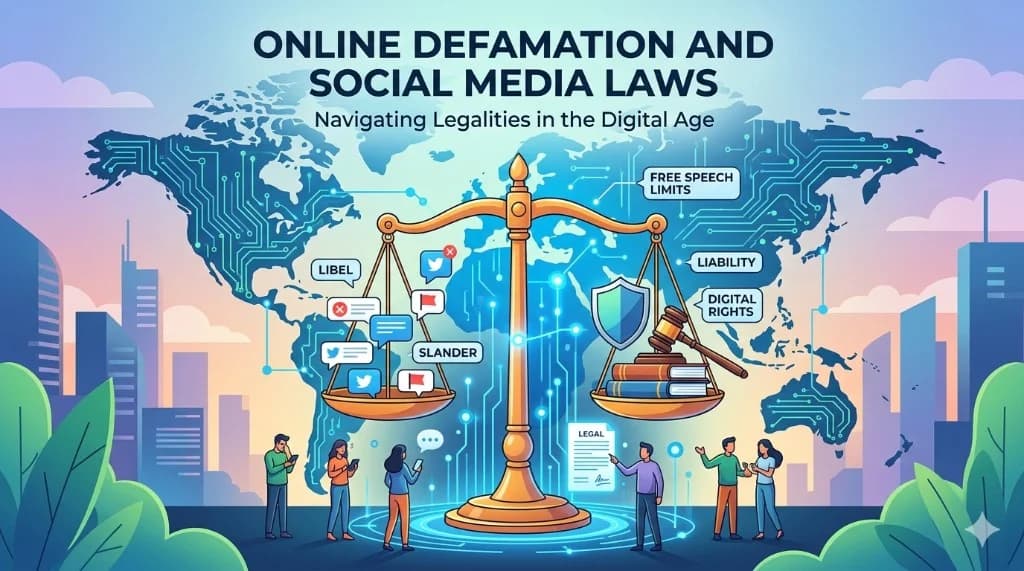
Online Defamation and Social Media Laws
When a Post Becomes a Case: The Law of Online Defamation in India
In an era where a single tweet can reach millions within minutes, and a false WhatsApp forward can destroy a business overnight, understanding the law of online defamation is essential — not just for lawyers, but for every person who communicates digitally.
What Is Defamation?
Defamation is the publication of a false statement of fact — through words, images, or any other representation — that harms the reputation of a person in the minds of right-thinking members of society. In India, defamation is both a criminal offence and a civil wrong.
For a statement to be defamatory, it must: (1) be false; (2) concern an identifiable person; (3) be published to at least one other person; and (4) cause reputational harm. Truth is an absolute defence in civil defamation and a partial defence in criminal defamation (if publication is also for public good).
The Legal Provisions
Criminal Defamation — BNS Section 356
Section 356 of BNS corresponds to the old Section 499 IPC and defines criminal defamation, including imputation through words, signs, or visible representations. Section 357 replaces IPC Section 500 and prescribes punishment up to 2 years imprisonment, fine, or both for criminal defamation.
Section 356(2) mentions the punishment for defamation which can be a term that may extend to two years, or fine, or both, or community service.
Electronic Documents Expressly Covered
The law of defamation in India is primarily interpreted by Section 356 of the BNS; the legislation has recently been expanded to include electronic documents. Electronic record forgery is covered under Section 336 of the BNS, which provides that anyone found guilty of forgery with the express purpose that the forged document or electronic record will damage the party's reputation faces up to three years in prison and a fine.
Civil Defamation
The tort of defamation allows a victim to sue for monetary damages and injunctions to remove defamatory content. Civil suits can be filed regardless of whether criminal proceedings are initiated. The limitation period for civil defamation is one year from the date of publication; for criminal complaints, three years.
IT Act Provisions
Any defamatory content posted online — tweets, blogs, videos — that harms reputation can attract Sections 66 and 67 of the IT Act alongside BNS Section 356.
Although Section 66A was struck down in Shreya Singhal v. Union of India (2015), platforms and intermediaries are still regulated under Section 79, which provides safe harbor if they act promptly on valid takedown requests.
Online and Cyber Defamation
Online defamation — or "cyber defamation" — occurs when the defamatory statement is made through electronic means: social media posts, tweets, Instagram stories, blog articles, WhatsApp forwards, YouTube videos, podcast comments, or emails circulated to multiple recipients.
Cyber defamation occurs when false or malicious information is shared online with the intent of damaging someone's reputation. It can happen on platforms like Facebook, Instagram, Twitter, or even through WhatsApp messages. Earlier, Section 66A of the Information Technology Act was used to deal with cyber defamation, but in 2015, the Supreme Court declared it unconstitutional. Despite this, cyber defamation is still punishable under other sections of the law, including Section 356 BNS.
Recent Cases
Multiple judgments illustrate enforcement: in political defamation cases, abusive posts against rival leaders have led to investigations. In trust and individual harm cases, videos maligning founders resulted in bans on uploading and sharing. Courts have granted injunctions across platforms including YouTube, Facebook, and the Metaverse.
Platform Liability
Under Section 79 of the IT Act, intermediaries — social media platforms, hosting services, messaging apps — enjoy safe harbour from liability for third-party content, provided they observe due diligence and act on valid takedown notices expeditiously. The IT Rules 2021 (as amended in 2026 for SGI) impose additional obligations: platforms must appoint a Grievance Officer, acknowledge complaints within 24 hours, and resolve them within 15 days.
If a platform fails to act on a notice of defamatory content, it can lose its safe harbour protection and become liable as a publisher rather than an intermediary.
Defences Against a Defamation Claim
Truth is the most complete defence. Fair comment on a matter of public interest — reviewing a book, criticising a public figure's official conduct, commenting on political decisions — is also protected. Privilege applies to statements made in Parliament, in judicial proceedings, or in other privileged contexts. Consent of the person allegedly defamed is a complete defence.
Practical Steps for Victims
Document everything immediately — screenshot the content with timestamps, note the URL, preserve the evidence in multiple formats. Send a legal notice to the individual and the platform demanding removal. File a complaint with the platform's Grievance Officer. Approach a civil court for an injunction and damages. File a criminal complaint with the cyber police for BNS Section 356 proceedings.
Key Provisions: BNS Section 356 and 357 · IT Act Section 66, 67, 79 · IT Rules 2021 (Grievance Mechanism) · Shreya Singhal v. Union of India (2015)