
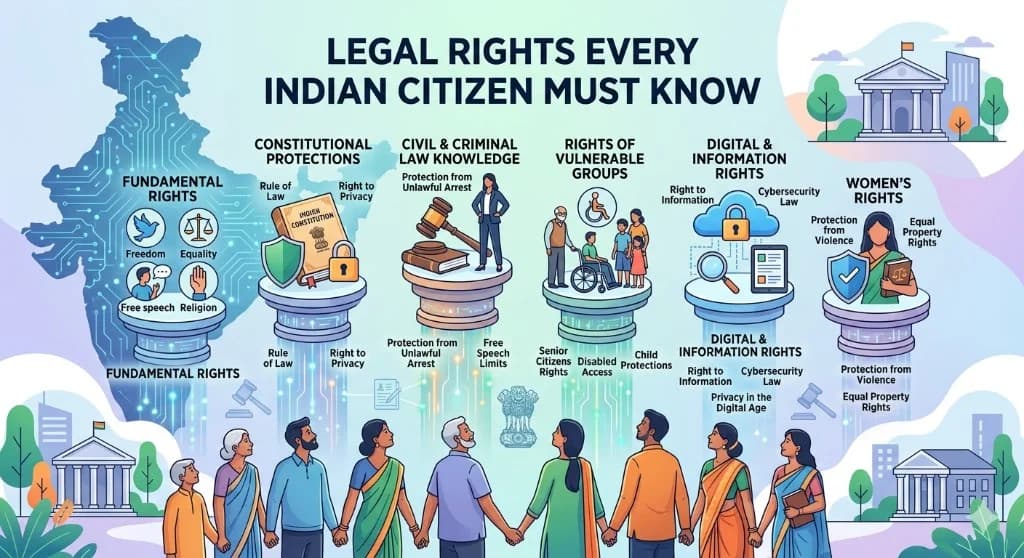
Legal Rights Every Indian Citizen Must Know
Your Rights as an Indian Citizen — From the Constitution to the Courtroom
India is a constitutional democracy. Its citizens are not subjects — they are rights-holders. Part III of the Constitution of India contains the Fundamental Rights: enforceable, justiciable, and protected against infringement by the State. Beyond the Constitution, statutes — the BNSS 2023, the BSA 2023, the Consumer Protection Act, the RTI Act, the DPDP Act 2023, and dozens of others — have layered specific rights over that constitutional foundation.
Yet surveys consistently show that a majority of Indians do not know their rights. This blog is a comprehensive but accessible guide to the legal rights every Indian citizen must know — organised by the situations in which those rights are most likely to be needed.
PART I — YOUR CONSTITUTIONAL RIGHTS: THE FOUNDATION
1. The Right to Equality (Articles 14–18)
Article 14 guarantees equality before the law and equal protection of the laws. No person — regardless of birth, religion, caste, sex, or place of origin — can be treated differently by the State without a reasonable and intelligible classification. Article 14 is the basis on which discriminatory laws and executive actions are struck down by courts.
Article 15 prohibits discrimination by the State on grounds of religion, race, caste, sex, or place of birth. It guarantees entry to public places, use of wells, tanks, roads, and public resorts to all citizens.
Article 16 guarantees equality of opportunity in matters of public employment — every citizen has an equal right to apply for government jobs. It also empowers the State to make reservation for backward classes, SC/ST communities, and economically weaker sections.
Article 17 abolishes untouchability and makes its practice in any form a punishable offence under the Protection of Civil Rights Act, 1955. Article 18 abolishes titles — no citizen of India can accept a title from a foreign state, and the State cannot confer hereditary titles.
2. The Right to Freedom (Articles 19–22)
Article 19 — Six Freedoms
Article 19 guarantees six freedoms to every citizen: freedom of speech and expression; freedom to assemble peaceably and without arms; freedom to form associations or unions; freedom to move freely throughout the territory of India; freedom to reside and settle in any part of India; and freedom to practise any profession, occupation, trade, or business.
These freedoms are not absolute — they are subject to reasonable restrictions on grounds of sovereignty, integrity, public order, decency, morality, contempt of court, defamation, or incitement to an offence. The Supreme Court has consistently held that restrictions must be proportionate to their objective and cannot be disproportionately wide.
Article 20 — Protection Against Arbitrary Conviction
Article 20 contains three critical protections. First, no person shall be convicted for an act that was not an offence under the law in force at the time it was committed (protection against ex post facto laws). Second, no person shall be prosecuted and punished for the same offence more than once (the protection against double jeopardy). Third, no person accused of any offence shall be compelled to be a witness against himself — the fundamental right against self-incrimination.
Article 21 — The Right to Life and Personal Liberty
Article 21 is the most expansive and most litigated fundamental right in the Indian Constitution. It states simply: "No person shall be deprived of his life or personal liberty except according to procedure established by law."
The Supreme Court has read into Article 21 an enormous range of rights including the right to privacy (K.S. Puttaswamy v. Union of India, 2017), the right to a dignified life, the right to livelihood, the right to health, the right to education (until age 14, also separately guaranteed by Article 21A), the right to a clean environment, the right to speedy trial, and the right to legal aid. Every time the State deprives a person of life or liberty, the procedure must be fair, just, and reasonable — not merely technically legal.
Article 22 — Protection Against Arbitrary Arrest and Detention
Article 22 provides protection to individuals in case of arrest and detention. Article 22(1) mandates that no person shall be detained in custody without being informed of the grounds for such arrest, nor shall they be denied the right to consult and be defended by a legal practitioner of their choice. Article 22(2) stipulates that every person arrested or detained must be produced before the nearest Magistrate within 24 hours, excluding the time necessary for travel.
3. Right Against Exploitation (Articles 23–24)
Article 23 prohibits trafficking in human beings and forced labour. Begar — the practice of compelling someone to work without wages — is expressly prohibited. Article 24 prohibits employment of children below fourteen years in any factory, mine, or hazardous employment.
4. Right to Freedom of Religion (Articles 25–28)
Article 25 guarantees every person the freedom of conscience and the right to freely profess, practice, and propagate religion, subject to public order, morality, health, and other fundamental rights. Articles 26, 27, and 28 protect religious denominational rights, the right not to be taxed for promotion of a particular religion, and the right not to be compelled to receive religious instruction in state-funded institutions.
5. Cultural and Educational Rights (Articles 29–30)
Every section of citizens with a distinct language, script, or culture has the right to conserve them. Religious and linguistic minorities have the right to establish and administer educational institutions of their choice.
6. Right to Constitutional Remedies (Article 32)
Dr. B.R. Ambedkar called Article 32 "the heart and soul of the Constitution." It gives every citizen the right to approach the Supreme Court directly for enforcement of fundamental rights. The Supreme Court can issue writs — Habeas Corpus, Mandamus, Prohibition, Certiorari, and Quo Warranto — to enforce any fundamental right that has been violated. Article 226 gives the High Courts the same writ jurisdiction, including for enforcement of legal rights beyond fundamental rights.
PART II — YOUR RIGHTS WHEN DEALING WITH POLICE
7. The Right to Know Why You Are Being Arrested
The arrested person is required to be informed of the grounds of arrest under Article 22(1) of the Indian Constitution, and of their right to have a relative or friend informed of the arrest. Under Section 47 BNSS, the arresting officer has a mandatory duty to communicate full particulars of the offence and grounds for arrest. Grounds must be furnished in writing and in a language understood by the person — a standard established by the Supreme Court in Pankaj Bansal v. Union of India (2023) and extended to general criminal arrests in 2024.
8. The Right to a Lawyer from the Moment of Arrest
The arrested person has the right to consult and be defended by a lawyer of their choice under Article 22(1) of the Constitution and Section 37 of the BNSS. For individuals who cannot afford legal services, the State is mandated to provide free legal aid, failing which the trial could be rendered null and void as a violation of the right to life and liberty under Article 21.
9. The Right to Inform a Family Member
Under Section 48 BNSS (formerly Section 50A CrPC), the arresting officer is obligated to inform a friend, relative, or nominated person about the arrest as soon as possible. The police must record the details of the person informed, along with the time and place of arrest.
10. The Right to Medical Examination
An arrested person must be examined for any injuries at the time of arrest, and an "inspection memo" must be prepared and signed by both the officer and the arrestee. They are entitled to a medical examination by a qualified doctor every 48 hours during detention.
11. The Right Against Custodial Violence
The D.K. Basu v. State of West Bengal (1997) guidelines, which have been given statutory backing through BNSS provisions, prohibit all forms of custodial violence. All police personnel must wear name tags clearly indicating their name and designation. The police officer making an arrest must prepare an Arrest Memo that records details of the arrest. One copy of all documents relating to the arrest must be sent to the Illaqa Magistrate.
If you are subjected to any form of physical violence, threat, or coercion in custody, you can file a complaint before the National Human Rights Commission, the State Human Rights Commission, or approach the High Court directly with a writ petition.
12. The Right Against Arrest of Women After Sunset
Under Section 43(6) of BNSS, no woman shall be arrested after sunset and before sunrise, except in exceptional circumstances and only by a woman police officer with prior permission from a Judicial Magistrate.
PART III — YOUR RIGHT TO INFORMATION
13. The Right to Information (RTI Act, 2005)
The Right to Information Act, 2005, gives every Indian citizen the right to access information held by public authorities. The basic object of the RTI Act is to empower citizens, promote transparency and accountability in the working of the Government, and contain corruption.
Under the provisions of the RTI Act, any citizen of India may request information from a public authority, which is required to reply within thirty days.
How to file an RTI: Write an application addressed to the Central Public Information Officer (CPIO) or State Public Information Officer (SPIO) of the relevant department. State the information you require specifically. Pay the application fee of ₹10 (BPL applicants are exempted). File online at rtionline.gov.in for central government matters or via the relevant state portal.
If no response is received within 30 days, or if the response is unsatisfactory, a first appeal lies to the First Appellate Authority within 30 days. A second appeal lies to the Central Information Commission or State Information Commission. Officers who fail to respond can be penalised ₹250 per day of default up to ₹25,000.
Exemptions from disclosure include national security and defence matters, matters barred by courts, commercial confidence and trade secrets, personal information implicating privacy, and ongoing investigations. However, Section 8(2) provides that if public interest outweighs the harm of disclosure, information may still be provided.
PART IV — YOUR CONSUMER RIGHTS
14. Rights Under the Consumer Protection Act, 2019
Every person who purchases a product or avails a service for personal use is a "consumer" under the Consumer Protection Act, 2019, and has six statutory rights: the right to be protected against hazardous goods; the right to be informed about quantity, quality, purity, price, and standard; the right to choose; the right to be heard; the right to seek redressal against unfair practices; and the right to consumer education.
Consumer Dispute Redressal Commissions operate at three levels:
- District Commission: for claims up to ₹1 crore
- State Commission: for claims between ₹1 crore and ₹10 crore
- National Commission: for claims above ₹10 crore
Filing a consumer complaint requires no lawyer. You can file it yourself, paying a nominal fee. The process is time-bound: a complaint should ideally be decided within five months of filing. E-filing is available at edaakhil.nic.in.
E-commerce purchases are specifically covered. Unfair trade practices by online platforms, including misleading product descriptions, manipulative pricing, and non-refund policies violating stated terms, are actionable under the Consumer Protection Act.
PART V — YOUR RIGHTS IN THE WORKPLACE
15. Rights Under Labour Law
Every employed person in India has a minimum set of workplace rights that cannot be contracted away regardless of what an employment agreement says:
Minimum Wages: The Minimum Wages Act, 1948 (to be replaced by the Code on Wages, 2019) ensures that no worker is paid below the minimum wage prescribed by the government for their category of work.
Provident Fund: Every establishment employing 20 or more workers must register under the Employees' Provident Fund Act. 12% of basic salary is contributed by the employee and matched by the employer.
ESIC (Employee State Insurance): Workers earning up to ₹21,000 per month in establishments with 10 or more employees are entitled to medical benefits, sickness benefits, maternity benefits, and disablement benefits under the ESIC scheme.
Protection from Sexual Harassment: The POSH Act, 2013 mandates that every organisation with 10 or more employees must constitute an Internal Complaints Committee. Any woman who experiences sexual harassment at work has the right to file a complaint within three months of the incident.
Gratuity: Any employee who has completed five years of continuous service with an employer is entitled to gratuity under the Payment of Gratuity Act, 1972, calculated at 15 days' salary for each year of service.
PART VI — YOUR DIGITAL RIGHTS
16. The Right to Privacy (Article 21 and DPDP Act, 2023)
In K.S. Puttaswamy v. Union of India (2017), the Supreme Court unanimously held that the right to privacy is a fundamental right under Article 21 of the Constitution.
The Digital Personal Data Protection Act, 2023, which came into operational force in November 2025, gives every individual the following digital rights: the right to know what personal data is being collected and for what purpose; the right to correction and erasure of inaccurate data; the right to withdraw consent for data processing; the right to raise grievances against organisations misusing your data; and the right to nominate a person to exercise these rights on your behalf.
The Data Protection Board of India was formally established on 13 November 2025. Its digital complaint portal is live. You can file a complaint against any organisation that has violated your data rights.
PART VII — YOUR RIGHT TO FAIR LEGAL PROCESS
17. The Right to Speedy Trial
The Supreme Court has held in multiple judgments that the right to a speedy trial is a component of the right to life under Article 21. Prolonged detention as an undertrial prisoner without trial violates Article 21. The BNSS 2023 has now introduced statutory time limits: summary trials must conclude within 45 days; regular trials should conclude within one year.
18. The Right to Free Legal Aid
Every woman, every SC/ST member, every person in custody, every victim of mass disaster, every industrial workman, every person with a disability, and every person below the prescribed income threshold has an absolute right to free legal representation through the Legal Services Authority.
Applications can be filed at the nearest District Legal Services Authority, online at nalsa.gov.in, or by calling the NALSA helpline at 15100.
19. The Right Against Double Jeopardy
Under Article 20(2), no person can be tried and punished twice for the same offence. If a person has been acquitted, convicted, or even tried for an offence, a second prosecution for the same offence arising from the same facts is barred. This protection is also codified in the BNSS.
20. The Right to Bail if Fundamental Rights Are Violated During Arrest
A 2025 Supreme Court bench held that once a Court, while dealing with a bail application, finds that the fundamental rights of the accused under Articles 21 and 22 of the Constitution have been violated while arresting the accused or after arresting him, it is the duty of the Court to release the accused on bail — because the arrest in such cases stands vitiated.
This is a critically important and underused right. If your arrest was made without informing you of the grounds, without providing a lawyer, or with custodial violence, that illegality can and should be placed before the court hearing your bail application as a ground for release.
PART VIII — YOUR RIGHT TO VOTE AND PARTICIPATE IN DEMOCRACY
21. The Right to Vote
Every citizen of India who is 18 years of age or above and whose name appears on the electoral roll has the right to vote in elections to the Lok Sabha, State Legislatures, and local bodies. This right derives from Article 326 of the Constitution and the Representation of the People Act, 1951.
Voters have the right to a secret ballot, the right to NOTA (None of the Above), and the right to challenge election results through an election petition.
22. The Right to Contest Elections
Every citizen who is 25 years or older and meets eligibility requirements has the right to contest elections to Parliament. The Supreme Court has held that voters have the right to know the criminal record and financial background of candidates — established in Union of India v. Association for Democratic Reforms (2002).
PART IX — YOUR ENVIRONMENT AND HEALTH RIGHTS
23. The Right to a Clean Environment
The Supreme Court has read the right to a clean and healthy environment into Article 21. Industries, developers, and government projects that violate environmental standards can be challenged through PIL. The National Green Tribunal (NGT) provides a specialised forum for environmental disputes and orders.
24. The Right to Health
The right to health and medical treatment has been recognised as part of Article 21. Government hospitals cannot deny emergency treatment to any patient. The denial of emergency medical care in a government facility is a constitutional violation actionable through a writ.
Conclusion: Rights Require Assertion
Rights that are not claimed are rights that do not exist in practice. The Constitution and statutes of India provide one of the world's most comprehensive frameworks of individual rights. The challenge is not the law — it is awareness, access, and assertion.
Know your rights. Know the NALSA helpline (15100). Know that RTI costs ₹10. Know that a lawyer must be provided to you from the moment of arrest. Know that no police officer can hold you beyond 24 hours without a magistrate's order. Know that your data has legal protection. Know that your consumer complaints have a dedicated, accessible forum.
An informed citizen is better equipped to exercise their rights and hold those in power accountable. The law is on your side. Learn it.
Key Statutes & Resources: Constitution of India (Part III) · BNSS 2023 · BSA 2023 · RTI Act 2005 · Consumer Protection Act 2019 · DPDP Act 2023 · POSH Act 2013 · Legal Services Authorities Act 1987 · NALSA Helpline: 15100 · RTI Portal: rtionline.gov.in · Cybercrime Portal: cybercrime.gov.in · Consumer E-filing: edaakhil.nic.in