
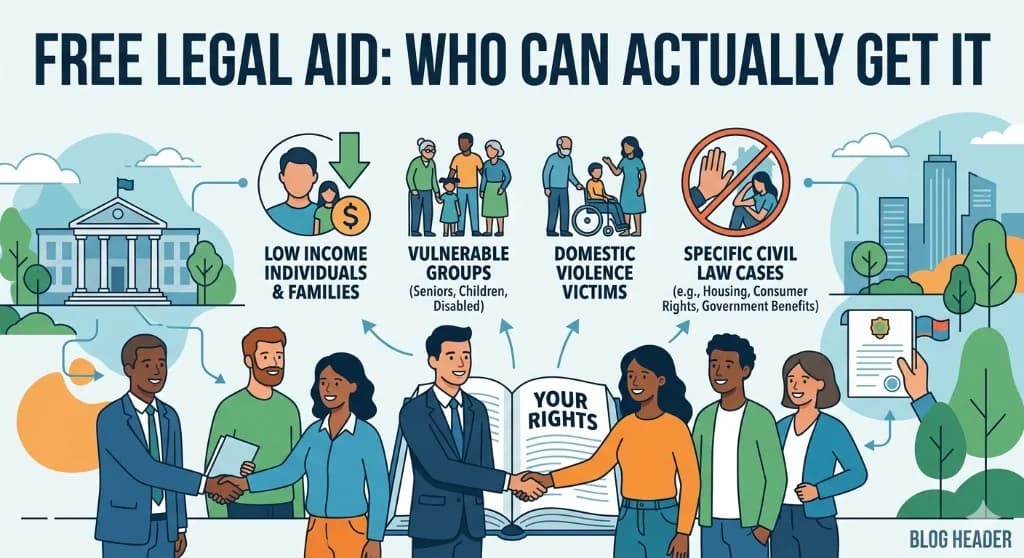
Free Legal Aid — Who Can Actually Get It
Free Legal Aid Is a Fundamental Right — But Most People Don't Know How to Claim It
Article 39A of the Constitution of India mandates that the State shall ensure that the operation of the legal system promotes justice on a basis of equal opportunity, and shall in particular provide free legal aid by suitable legislation or schemes to ensure that opportunities for securing justice are not denied to any citizen by reason of economic or other disabilities.
Free legal aid is not charity. It is a constitutional entitlement. Yet the majority of eligible Indians never claim it — either because they don't know they qualify, or because they don't know how to apply.
The Governing Framework
The Legal Services Authorities Act, 1987 established the National Legal Services Authority (NALSA) as the apex body for legal aid in India. Below NALSA, every state has a State Legal Services Authority (SLSA), every district has a District Legal Services Authority (DLSA), and every taluk has a Taluk Legal Services Committee. This is a four-tier structure designed to take legal aid to the grassroots.
Who Is Entitled to Free Legal Aid?
According to the Legal Services Authorities Act, 1987, the following categories are entitled to free legal aid in India: women and children (below 18 years), members of SC/ST communities, victims of human trafficking or beggars, industrial workmen, mentally ill or disabled individuals, persons in custody (including undertrial prisoners), victims of mass disaster, ethnic violence, or natural calamities, and individuals with annual income below ₹3 lakhs (₹5 lakhs in some states).
Women — No Income Limit
A woman is entitled to free legal aid irrespective of her income or financial status. A woman is eligible to apply for free legal aid by virtue of Section 12(c) of the Legal Services Authorities Act, 1987. This applies to all proceedings — matrimonial cases, criminal matters, domestic violence proceedings, employment disputes, and any civil litigation.
Undertrial Prisoners
Every person in custody has the right to free legal representation. This is an absolute entitlement regardless of income. Under Section 304 BNSS (formerly Section 304 CrPC), courts must ensure that accused persons who cannot afford a lawyer are provided one at the State's expense.
Income-Based Eligibility
For cases before the Supreme Court, the income threshold is less than ₹5 lakh. For cases before any other court, the income threshold is less than the amount prescribed by the respective State Government. The eligibility threshold varies by state, generally ₹3 lakhs or below for most states.
SC/ST Members
Scheduled Caste and Scheduled Tribe members are entitled to free legal aid regardless of income — as an automatic entitlement under Section 12(b) of the Act.
Acid Attack Victims
NALSA has a dedicated scheme — NALSA (Legal Services to Victims of Acid Attacks) Scheme, 2016 — providing free legal aid and assistance to acid attack survivors for compensation claims, criminal proceedings, and civil remedies.
What Services Does Free Legal Aid Cover?
Free legal aid covers: legal advice and consultation, drafting of petitions and plaints, representation before courts, tribunals, and quasi-judicial bodies, filing of appeals, Lok Adalat proceedings, and legal literacy assistance. It does not cover court fees (which are waived separately for certain categories of litigants) or expenses unrelated to legal representation.
How to Apply
You can apply for free legal aid either offline or online. You can fill up the application form available at your nearest Legal Services Authority and submit it physically, or post the application. Alternatively, you can send the application online. As per Section 13(2) of the Act, an affidavit made by a person as to their income is generally regarded as sufficient for making them eligible for legal services.
Online applications can be made through the NALSA portal (nalsa.gov.in). The National Legal Aid Helpline number is 15100.
Lok Adalats — Alternative Dispute Resolution for Free
Lok Adalats are people's courts convened by legal services authorities to settle disputes through conciliation. There are no court fees in Lok Adalat proceedings. Any award passed by a Lok Adalat is deemed a decree of a civil court and is final and binding — not subject to appeal. They are particularly effective for motor accident claims, matrimonial disputes, labour matters, and dishonoured cheque cases.
NALSA has been instrumental in establishing legal aid clinics, Lok Adalats, and legal awareness camps to bring legal assistance closer to the grassroots level.
NALSA's Special Schemes
NALSA operates numerous targeted schemes including: NALSA (Protection and Enforcement of Tribal Rights) Scheme, 2015; NALSA (Legal Services to the Victims of Drug Abuse) Scheme, 2015; NALSA (Legal Services to Senior Citizens) Scheme, 2016; NALSA (Legal Services to Victims of Acid Attacks) Scheme, 2016; and NALSA's Compensation Scheme for Women Victims/Survivors of Sexual Assault/other Crimes, 2018.
The Reality Gap
Despite a robust statutory framework, free legal aid in India faces significant implementation challenges: shortage of trained panel lawyers, inadequate compensation for legal aid counsel, low awareness among eligible communities, and quality disparities between panel advocates and private lawyers. Legal literacy remains low, particularly in rural areas and among women, who form the single largest entitled category.
The solution, as repeatedly noted by the Law Commission and the Supreme Court, lies not just in expanding legal aid but in ensuring its quality — trained, committed advocates who treat legal aid cases with the same seriousness as paid retainers.
Key Statutes: Legal Services Authorities Act 1987 · Article 39A Constitution · BNSS Section 304 · NALSA Schemes · Helpline: 15100 · Portal: nalsa.gov.in