
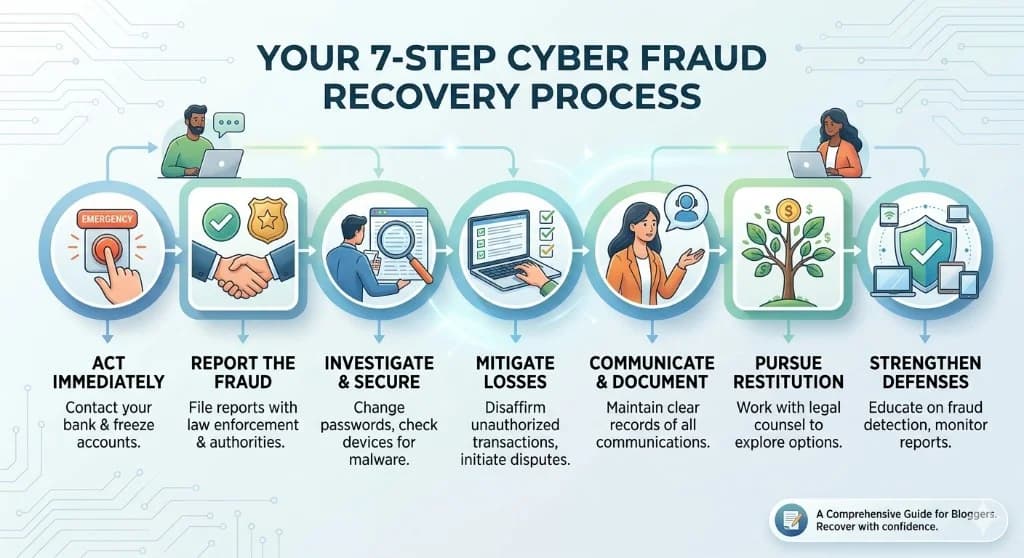
Cyber Fraud Recovery Process
What to Do the Moment You Realise You Have Been Defrauded Online
Cyber fraud in India is rising at an alarming rate — from UPI scams and investment fraud to digital arrest hoaxes and romance scams. The difference between recovering your money and losing it permanently often comes down to the first hour after the fraud is discovered.
This is a practical, step-by-step guide to the legal and procedural options available to cyber fraud victims in India in 2026.
Step 1 — Call 1930 Immediately
The first few hours after a cyber fraud are extremely important. If you report the incident immediately, authorities may be able to freeze the fraudster's bank account and recover your money. For financial fraud cases, citizens are advised to call the national cyber helpline 1930 as soon as possible.
Report on the National Cyber Crime Reporting Portal at cybercrime.gov.in and call the national helpline 1930 within the first hour. Simultaneously inform your bank's fraud helpline to block transactions.
The 1930 helpline operates 24/7 and is connected to the Citizen Financial Cyber Fraud Reporting and Management System. When you call, give the fraudster's bank account number or UPI ID, the amount lost, the transaction reference, and the time of the fraud. The system can initiate a lien on the destination account before the money is moved further.
Step 2 — Notify Your Bank
Call your bank's fraud helpline immediately and report the unauthorised transaction. For UPI fraud, contact the UPI app's helpline as well. Request a temporary freeze on outward transactions from your account pending investigation.
Under RBI guidelines, banks are required to investigate disputed transactions. If the fraud resulted from a bank system failure rather than user negligence, the bank may be liable for the full amount. If user negligence contributed, partial liability rules apply under the RBI's framework on limiting customer liability.
Step 3 — File a Complaint on cybercrime.gov.in
The primary avenue for cybercrime complaint filing is the National Cybercrime Reporting Portal at cybercrime.gov.in. This portal, managed by the Indian Cybercrime Coordination Centre (I4C), provides a centralised platform for reporting various cybercrimes. Your complaint will receive a unique reference number for tracking purposes.
Gather all evidence before filing: screenshots of messages, transaction IDs, email chains, website URLs, UPI IDs, phone numbers used by the fraudster, and any documents you were shown. Strong, contemporaneous evidence significantly accelerates the investigation.
Step 4 — The e-Zero FIR Initiative (for Losses above ₹10 Lakh)
The Ministry of Home Affairs' Indian Cybercrime Coordination Centre (I4C) introduced the e-Zero FIR initiative in May 2025. Complaints related to financial losses above ₹10 lakh made to NCRP and 1930 automatically lead to registration of a Zero FIR with the e-Crime Police Station of Delhi.
For smaller amounts, a portal complaint suffices initially, but you may also approach your local cyber crime cell to register a regular FIR for a cognisable offence under the IT Act or BNS.
Step 5 — Legal Provisions Under Which Cases Are Filed
- IT Act, Section 66C — Identity theft (using another's digital identity for gain).
- IT Act, Section 66D — Cheating by personation using computer resources.
- BNS, Section 318 — Cheating — the general provision for financial fraud.
- BNS, Section 319 — Cheating by personation.
- BNS, Section 336 — Forgery of electronic records.
For cyber fraud involving amounts above ₹30 lakh with cross-border elements, the Enforcement Directorate can initiate proceedings under the Prevention of Money Laundering Act, 2002.
What Are the Realistic Recovery Chances?
National recovery rates improved from 10-11% in 2024 to 24% in 2025, with prompt reporting within 6 hours significantly increasing recovery chances. Speed matters more than amount.
The government has reported that more than ₹7,000 crore has been saved through the cyber fraud reporting system. Recovery is most likely when: the fraud is reported within the first hour, the destination account is a domestic bank account, the fraudster has not yet transferred funds further, and the bank cooperates swiftly with the freeze request.
Recovery becomes significantly harder once funds are converted into cryptocurrency, transferred abroad, or dispersed across multiple mule accounts.
Awareness: Common Scams to Know in 2026
The I4C has identified the following as the most prevalent cyber fraud vectors in India: digital arrest scams (where fraudsters impersonate police or ED officers and demand money), investment scams promising guaranteed returns, fake loan app fraud, malware-based bank credential theft, romance scams, and fake social media advertisements.
I4C in collaboration with the Department of Telecommunications launched a caller tune campaign for raising awareness about cybercrime and promoting the Cybercrime Helpline Number 1930, broadcast in English, Hindi and 10 regional languages covering various modus operandi including digital arrest, investment scams, malware, fake loan apps, and fake social media advertisements.
Key Resources: cybercrime.gov.in · Helpline: 1930 · I4C (Indian Cybercrime Coordination Centre) · RBI Ombudsman · PMLA/ED (for high-value cases)