
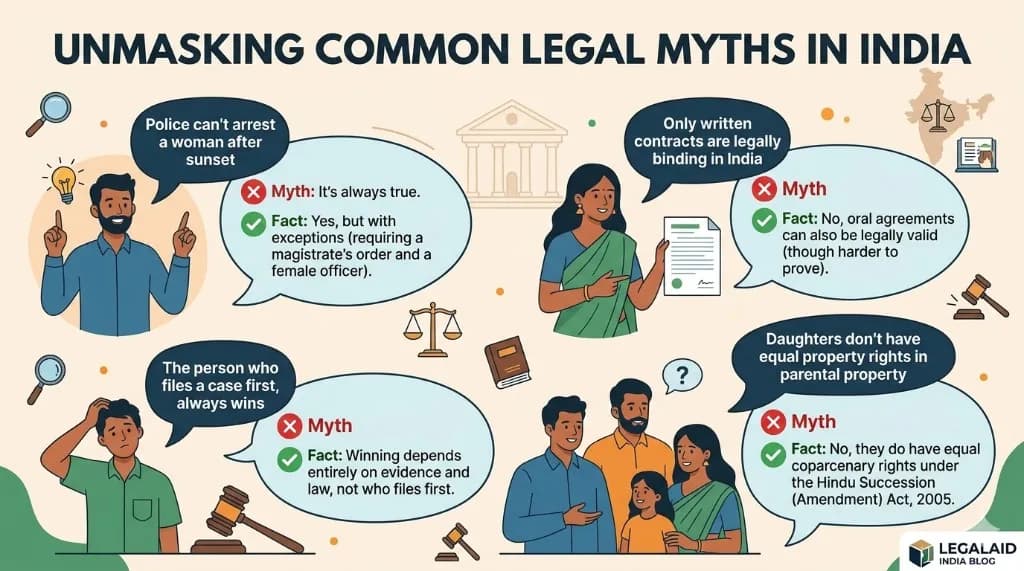
Common Legal Myths in India
What You Think You Know About Indian Law — and Why You're Probably Wrong
Most Indians have never read a law. What they know about the legal system comes from three sources: Bollywood, WhatsApp forwards, and half-remembered school civics. The result is a population that confidently believes things about the law that are either completely false, dangerously oversimplified, or simply outdated.
Legal myths are not harmless. A person who believes the police cannot arrest without a warrant may refuse to cooperate in a situation where cooperation protects them. Someone who believes a stamp paper agreement is always binding may sign away rights they didn't need to. A tenant who believes their landlord can throw them out with a phone call may abandon their home unnecessarily.
This blog takes fifteen of the most persistent legal myths circulating in India today and sets the record straight — with the relevant law, the applicable provision, and the cases that shaped what the truth actually is.
MYTH 1: "The Police Cannot Arrest You Without a Warrant"
The Truth: The police absolutely can — and routinely do — arrest without a warrant, but only for cognizable offences.
Under Section 35 of the BNSS 2023 (formerly Section 41 of the CrPC), a police officer may arrest a person without a warrant if the person has committed, is committing, or is about to commit a cognizable offence. Cognizable offences include murder, robbery, rape, kidnapping, theft, cheating, and hundreds of other serious crimes. In cognizable offences, police may arrest without a warrant according to law.
What the police cannot do is arrest arbitrarily. In Arnesh Kumar v. State of Bihar (2014), the Supreme Court held that arrest should not be made in a mechanical manner and that for offences punishable with imprisonment up to seven years, a notice under Section 41A CrPC (now Section 35(3) BNSS) should first be issued before arrest is effected. The Arnesh Kumar guidelines require police to record in writing the reasons why arrest is necessary in a given case, and magistrates must apply their mind before authorising continued detention.
For non-cognizable offences — minor offences like public nuisance, simple assault, or defamation — police require prior permission from a magistrate before arrest. In non-cognizable offences, police generally require permission from a magistrate before investigation or arrest.
What this means for you: If a police officer approaches you and claims to be arresting you for a cognizable offence, they do not need to show you a warrant. But they must inform you of the grounds for your arrest, and the arrest must satisfy the conditions under Section 35 BNSS.
MYTH 2: "You Can Be Held at the Police Station for as Long as They Want"
The Truth: No person can be detained by the police for more than 24 hours without being produced before a magistrate.
Article 22(2) of the Constitution requires that every person arrested or detained must be produced before the nearest Magistrate within 24 hours, excluding the time necessary for travel. This requirement is designed to ensure that an independent judicial authority reviews the detention without undue delay.
Under Section 58 BNSS (formerly Section 57 CrPC), a person arrested shall not be detained more than 24 hours without a court order.
If police need to detain you further for investigation, they must produce you before a Judicial Magistrate who alone has the authority to grant judicial remand. A recent 2025 Supreme Court ruling arising from the Worli BMW accident case held that grounds of arrest must be furnished in writing and in a language understood by the person, establishing what is now known as the "two-hour rule" framework under Article 22(1). Providing an arrest memo alone is not enough; the arrested person must actually be communicated the grounds.
What this means for you: If you are being held at a police station beyond 24 hours without being produced before a magistrate, your detention is unconstitutional. You — or a family member or lawyer on your behalf — can file a Habeas Corpus petition before the High Court under Article 226 of the Constitution to secure immediate release.
MYTH 3: "You Must Answer Every Question the Police Ask"
The Truth: You have a fundamental right to remain silent when questioned about matters that may incriminate you.
Article 20(3) of the Indian Constitution states that no person accused of any offence shall be compelled to be a witness against himself. The right to remain silent emanates from this very Article.
In Nandini Satpathy v. State of Orissa (1978), Justice Krishna Iyer held that no person can be forced to answer questions which would expose them to guilt, penalty, or forfeiture. The Court further stated that the right to silence extends to police investigations — not just courtrooms.
There is an important limitation: you must answer basic identity questions — your name, address, and occupation. The right to silence applies specifically to questions that may incriminate you.
Under Section 161(2) CrPC (and its equivalent under the BNSS), no person can be forced to answer questions that may expose them to a criminal charge.
What this means for you: If police ask you questions during an investigation that, if answered, could form evidence against you in a criminal case, you are entitled to say — politely and clearly — "I wish to consult my lawyer before responding." That silence cannot be treated as an admission of guilt. Preventing abuse of power protects citizens from coercion or torture, ensures a fair trial by keeping the burden of proof on the prosecution, and prevents wrongful convictions based on forced confessions.
MYTH 4: "A Stamp Paper Agreement is Always Legally Valid and Binding"
The Truth: Writing something on a stamp paper does not automatically make it legal, enforceable, or valid.
A stamp paper is simply a piece of paper pre-printed with a revenue stamp, purchased from government-licensed vendors. It is used to comply with the Indian Stamp Act — which requires certain documents to be executed on stamp paper of the correct denomination to be admissible as evidence and to avoid penalty. However, a document executed on stamp paper is only as valid as its contents. A contract that lacks the essential elements — offer, acceptance, consideration, free consent, and lawful object — is void regardless of what paper it is written on.
The Calcutta High Court in Deep Dey v. State of West Bengal (2026) held that a purported marriage based solely on signing a non-judicial stamp paper is legally invalid under Hindu law and cannot form the basis for criminal prosecution for bigamy or matrimonial cruelty. The judgment confirms that agreements on stamp paper cannot substitute the mandatory ceremonies required for a valid Hindu marriage.
The Indian Contract Act does not specify any required format — typed, handwritten, or oral — for an agreement. As long as it clearly reflects the mutual intention and consent of the parties and meets the essential elements, it can be upheld by a court.
Moreover, stamp paper has a validity period. In many states, a stamp paper more than six months old from its date of purchase cannot be used for execution of a document. An agreement executed on an expired stamp paper may not be admissible in evidence.
What this means for you: Do not assume that any document placed before you on stamp paper is automatically legitimate or that signing it creates irrevocable obligations. If you are presented with a stamp paper document in an unfamiliar context, always insist on time to read, understand, and if needed, consult a lawyer before signing.
MYTH 5: "An Oral Agreement is Not Valid in India"
The Truth: Oral agreements are entirely valid under Indian law if they satisfy the essential conditions of a contract.
The Indian Contract Act does not specify any required format — typed, handwritten, or oral — for an agreement. Oral agreements are also valid under Indian law if they meet all legal conditions. The challenge is not validity — it is proof.
The essential elements of a valid contract under the Indian Contract Act, 1872 are: offer and acceptance, lawful consideration, free consent, competence of parties, and lawful object. If all these elements are present in an oral transaction, the contract is enforceable in a court of law.
The practical difficulty is evidentiary. If one party denies the existence or terms of an oral agreement, the other must prove it — through witnesses, conduct, exchange of messages, payment records, or any other admissible evidence. This is why lawyers consistently advise reducing important agreements to writing: not because an oral contract is invalid, but because it is exponentially harder to prove.
There are exceptions — certain types of agreements must be in writing and registered by law: sale or mortgage of immovable property (Transfer of Property Act), agreements to lease land for more than one year, and insurance contracts are examples of transactions that cannot be oral.
What this means for you: If you have made an oral agreement for a significant transaction — a business partnership, a loan, a property arrangement — document it as quickly as possible. Send a confirmatory message or email. Keep records of performance. The agreement may be valid, but without documentation, enforcing it is a battle.
MYTH 6: "A Landlord Can Evict a Tenant Whenever They Want"
The Truth: A landlord cannot evict a tenant without a court order. Forceful eviction is illegal.
A landlord cannot evict a tenant without due process of law. Eviction must be backed by valid legal grounds and carried out through a court decree. Grounds include non-payment of rent, breach of agreement, landlord's personal use, demolition or renovation needs, lease expiry, and illegal use of premises.
The eviction of a tenant is a civil matter and thus the police cannot directly evict a tenant in India. The landlord must approach a court and get an eviction order. However, the police can assist the landlord to evict a tenant when there is an eviction order from the court.
Cutting off electricity, water, or access to the property to coerce a tenant into leaving is illegal. Removing a tenant's belongings without a court order is illegal. Changing the locks while the tenant is absent is illegal. These acts constitute wrongful eviction and expose the landlord to civil liability and potentially criminal liability under provisions on criminal trespass and destruction of property.
The Supreme Court has ruled that even an unlawful tenant's possession is protected under law — no person can be dispossessed without due process. Article 21 of the Constitution safeguards tenants from forceful eviction.
What this means for you: If your landlord is threatening to throw you out, change your locks, or cut utilities, they are acting outside the law. You can approach the Rent Authority (under the applicable state Rent Control Act) or file a civil suit for injunction. You can also file a police complaint for illegal trespass.
MYTH 7: "Not Knowing the Law is a Valid Defence"
The Truth: Ignorance of the law excuses no one. This is one of the oldest and most fundamental principles in jurisprudence — ignorantia juris non excusat.
Every person is presumed to know the law. This presumption is a legal fiction, yes — but it is a necessary one. If ignorance of law were a defence, everyone would simply claim not to have known that an act was illegal. The entire system of criminal liability and civil obligation would become unenforceable.
Ignorance of the law is almost never a valid legal defence. Whether you are aware of the law or not, you are still responsible for following it.
There is a narrow exception in some circumstances under the Indian Penal Code — now replaced by the BNS — where a mistake of fact (not a mistake of law) can negate the mens rea required for a criminal offence. If you reasonably but incorrectly believed that a fact existed which, had it actually existed, would have made your act lawful, that is a mistake of fact. But acting on the assumption that a law does not apply to you because you did not know it existed is not a mistake of fact — it is ignorance of law, which provides no defence.
What this means for you: "I didn't know I needed to pay GST." "I didn't know that post was defamatory." "I didn't know my employee needed ESIC coverage." None of these are defences. Knowledge of the law is a personal responsibility, and legal compliance is not optional simply because the rules are complex.
MYTH 8: "Police Cannot Enter Your Home Without Permission"
The Truth: Police can enter your home without your permission if they have a search warrant issued by a magistrate — or, in certain urgent cognizable offence situations, even without one.
Section 94 of the BNSS (formerly Section 93 CrPC) empowers a magistrate to issue a search warrant. Once a warrant is issued, a police officer is authorised to enter and search the premises specified in the warrant. Your permission is not required; resistance can itself become an offence.
In cognizable offence cases where the officer has reason to believe that a person who may be arrested is concealed in a premises, or that evidence may be destroyed, Section 47 of the BNSS permits entry without a warrant after announcement and attempted demand of entry.
However, the law does protect you from random, undocumented searches. The DK Basu guidelines require that police prepare full documentation for any search and maintain records. An entry in the diary is required at the place of detention, and all documents must be provided to the magistrate.
What police cannot do is enter your home without a warrant merely to intimidate, or conduct a "general search" without a judicially authorised warrant. Narco-analysis, polygraph, and BEAP tests cannot be performed without voluntary, written consent before a magistrate — whether or not you are at home or in custody.
What this means for you: If police arrive at your door, you are entitled to ask them to show their warrant. If they have a valid warrant, you should allow entry but note all details. If they do not have a warrant and the situation does not fall under the emergency exceptions, you are entitled to deny entry and consult a lawyer.
MYTH 9: "Bail is Automatic for Bailable Offences"
The Truth: Bail is a right for bailable offences, but it does not happen automatically — you must apply for it.
In a bailable offence, the accused has the legal right to obtain bail. These offences are generally less serious. In non-bailable offences, bail is not automatic — the court decides whether bail should be granted based on several factors.
Every person arrested has the right to be informed of their right to bail. The BNSS mandates that when a police officer arrests a person without a warrant who has been accused of a bailable offence, the officer shall inform the person of their right to bail.
For bailable offences, the police officer at the station has the authority to release you on bail. You are entitled to bail as of right — but you must exercise that right by making a formal application and furnishing sureties as required. The police cannot simply release you on bail without the application and surety formalities.
For non-bailable offences, bail is entirely at the court's discretion. The court considers: the nature and gravity of the accusation, the antecedents of the accused, the possibility of flight, and the likelihood that the accused will interfere with witnesses or tamper with evidence.
What this means for you: If you are arrested for a bailable offence, immediately request the station house officer for bail. If bail is unreasonably refused, approach the Chief Judicial Magistrate or the Sessions Court. A 2025 Supreme Court bench held that once a court finds that the fundamental rights of the accused under Articles 21 and 22 have been violated during or after arrest, it is the duty of the court to release the accused on bail — the arrest in such cases stands vitiated.
MYTH 10: "A Confession to the Police is Valid Evidence in Court"
The Truth: A confession made to a police officer is not admissible as evidence in a criminal trial in India.
This is one of the most important protections in Indian evidence law and one of the least known. Section 25 of the Indian Evidence Act — now largely replicated in the BSA 2023 — provides that no confession made to a police officer shall be proved as against a person accused of any offence.
The rationale is straightforward: the potential for coercion in police custody is too high. A confession extracted through force, threat, or inducement is not voluntary and therefore not reliable. By excluding all confessions to police from evidence, the law removes the incentive for coercive interrogation entirely.
A confession to the police is inadmissible in court. If you have made a statement, tell your lawyer immediately and retract the statement in writing at your first appearance before the Magistrate.
There is an important exception: under Section 39 of the BSA 2023 (the successor to Section 27 of the Indian Evidence Act), a statement made to police that leads to the discovery of a fact — for example, "I hid the weapon in the warehouse at the following location" — is admissible to the extent that it directly relates to that discovery. The fact discovered becomes the evidence, and the statement leading to it is proved through the discovery. But the confession itself remains inadmissible.
A confession made before a Judicial Magistrate, in contrast, is admissible under Section 164 BNSS, provided it is made voluntarily after the magistrate warns the accused that they are not obliged to confess and that what they say may be used against them.
What this means for you: Never believe that making a statement to the police, under any circumstances, will help your case or lead to your release. It will not — because it cannot be used to exonerate you in court either. Speak to a lawyer first.
MYTH 11: "Only Men Have Property Rights in India"
The Truth: Under the Hindu Succession (Amendment) Act, 2005, daughters have equal coparcenary rights in ancestral property — identical to sons.
Before the 2005 amendment, daughters were not coparceners in a Hindu Undivided Family (HUF). They could inherit self-acquired property through a will, but ancestral property passed through male lines. The 2005 amendment fundamentally changed this: daughters are now coparceners by birth in the same way sons are, with the same rights of ownership, the same rights to demand partition, and the same liability to be charged with the debts of the estate.
The Supreme Court in Vineeta Sharma v. Rakesh Sharma (2020) settled all remaining ambiguity: the amendment applies to daughters regardless of whether their father was alive when the amendment came into force in 2005. A daughter born before 2005 has identical coparcenary rights to a son.
Indian law has evolved significantly in recent years, particularly with regard to women's property rights. The common misconception that only men have the right to own and inherit property has led to a lack of awareness about women's legal rights in property matters.
Women also have full rights under the Transfer of Property Act to buy, sell, mortgage, and lease property in their own names, independent of any male family member.
What this means for you: Any woman who has been told she has no right to her father's ancestral property should immediately consult a lawyer. She may have a live claim — depending on when partition (if any) occurred and whether her rights were properly accounted for.
MYTH 12: "Filing an FIR Means You Will Automatically Be Arrested"
The Truth: Filing an FIR initiates a criminal investigation — it does not automatically lead to arrest.
An FIR is the document that sets the criminal justice process in motion. Once registered, the police investigate the alleged offence. Investigation may result in arrest, but it does not automatically do so. The police may issue notices, record statements, seek documents, or determine after investigation that no cognizable offence is made out.
In Lalita Kumari v. State of UP (2014), the Supreme Court mandated that police must register an FIR if the complaint discloses a cognizable offence. However, registration of an FIR does not equal arrest — arrest is governed by the separate conditions under Section 35 BNSS and the Arnesh Kumar guidelines.
The fear of being arrested after a complaint is often weaponised — people are told "if you file an FIR against me, I will file one against you and you will be arrested." This is a pressure tactic. The filing of a counter-FIR does not result in automatic arrest of the original complainant, and the police must independently assess whether the conditions for arrest are met in any individual case.
What this means for you: Do not be deterred from filing a legitimate complaint by the threat of a counter-FIR or arrest. The police must have independent grounds to arrest; the mere existence of an FIR is not such a ground.
MYTH 13: "Wills Are Only for the Rich"
The Truth: A will is one of the most useful legal documents any person who owns anything can create — regardless of the size of their estate.
There is a common misconception that only wealthy individuals need to make a will. This myth is particularly prevalent in India, where many people may feel they do not need a will if they don't have significant assets. A will is an important legal document for everyone, regardless of their wealth.
Without a will, property passes according to the applicable succession law — the Hindu Succession Act for Hindus, the Indian Succession Act for Christians and Parsis, and Muslim Personal Law for Muslims. These default rules may not match your actual wishes. Property may go to estranged relatives, minor children may inherit without a guardian being specified, and disputed successions can tie up assets in court for years.
A will under Indian law does not require a lawyer or a stamp paper. It must be in writing, signed by the testator, and attested by at least two witnesses who are not beneficiaries. It can be written by hand, typed, or even recorded in some forms. It can be changed or revoked at any time during the testator's lifetime.
The Indian Succession Act, 1925 governs wills for most communities, and any person who believes they have been unfairly excluded from a will can challenge it in the probate court on grounds of fraud, undue influence, or lack of testamentary capacity.
What this means for you: If you have a bank account, a piece of land, a flat, savings, jewellery, or any other asset, you should have a will. It does not need to be elaborate or expensive. It needs to be clear, witnessed, and kept in a safe place known to your family.
MYTH 14: "Marriage on Stamp Paper is a Valid Legal Marriage"
The Truth: Writing a marriage agreement on stamp paper does not constitute a legal marriage under any personal law in India.
The Calcutta High Court in 2026 confirmed that a contractual marriage recorded on stamp paper is a legal nullity under Hindu law and cannot form the basis of criminal prosecution for bigamy or cruelty. The judgment confirmed that agreements on stamp paper cannot substitute the mandatory ceremonies required for a valid Hindu marriage.
Under the Hindu Marriage Act, a valid Hindu marriage requires performance of customary rites and ceremonies, of which the saptapadi (seven steps around the sacred fire) is typically essential and legally required. Under Muslim Personal Law, a nikah requires offer and acceptance, witnesses, and consideration (mehr). Under the Special Marriage Act, registration after notice and in-person appearance before a Marriage Officer is mandatory.
A stamp paper "marriage agreement" is a document — it is not a marriage ceremony. It cannot substitute for the legal requirements of any personal law or the Special Marriage Act.
This myth is particularly dangerous because people who enter such "agreements" may believe they have legal protections — maintenance rights, inheritance rights — that do not in fact exist because no valid marriage was ever contracted.
What this means for you: Whether you marry under a personal law or the Special Marriage Act, ensure the marriage is properly solemnised according to law and registered. A registered marriage certificate is your proof of marriage for all legal purposes — passports, joint bank accounts, insurance nominations, and succession.
MYTH 15: "You Only Need a Lawyer When You Go to Court"
The Truth: Lawyers are most valuable before you reach court — and engaging one early can prevent you from reaching court at all.
By the time most people consult a lawyer, they are already in trouble: they have signed a bad contract, made statements to the police, missed a deadline for challenging an action, or allowed a limitation period to expire. The legal system has limitation periods for virtually everything — civil suits, criminal complaints, service matters, and consumer cases — and once those periods expire, the remedy is gone regardless of the merits.
Legal advice at the stage of contract drafting prevents disputes. Legal review of a property document before purchase prevents title fraud. A lawyer's input before signing employment contracts or non-disclosure agreements protects rights. Consulting a lawyer before making any statement to police or any regulatory authority is a constitutionally guaranteed right under Article 22(1).
According to Article 22(1), the arrested person has the right to consult and be defended by a lawyer of their choice. This right is vital for ensuring a fair trial and protecting the individual from the coercive atmosphere of police custody.
For those who cannot afford a lawyer, free legal aid is available — every woman, every SC/ST member, every person in custody, and every person below the prescribed income threshold is entitled to representation through the Legal Services Authority. The NALSA helpline is 15100.
What this means for you: Think of a lawyer the way you think of a doctor — you should consult one regularly, not only in emergencies. Preventive legal advice is almost always cheaper than litigation.
Key Takeaway
Indian law is detailed, protective, and increasingly citizen-centric with the BNS, BNSS, and BSA framework in force since July 2024. But its protections work only for those who know they exist. Legal literacy is not a luxury — it is the foundational requirement for exercising any of the rights that follow.