
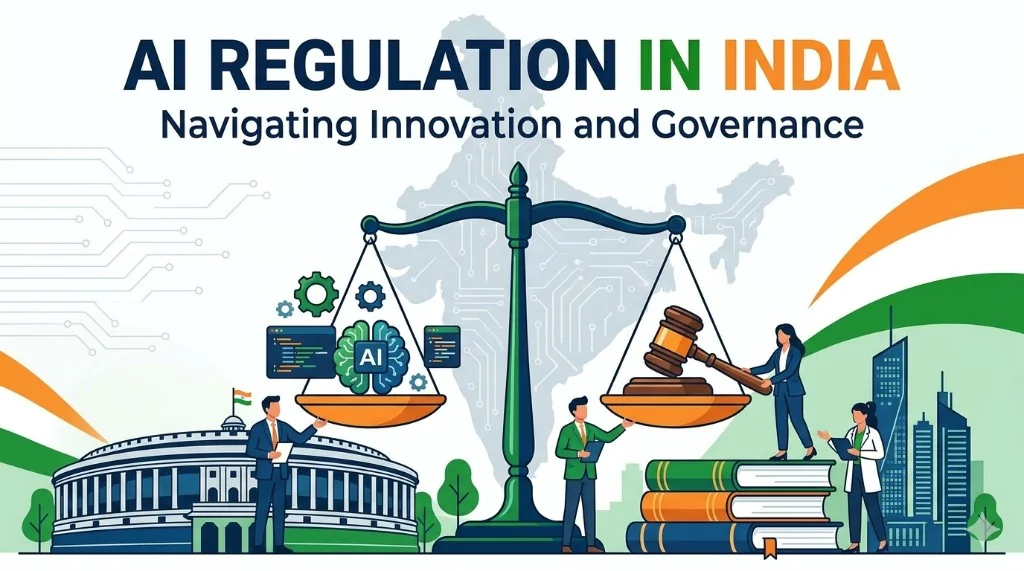
AI Regulation in India
India's Evolving Framework for Governing Artificial Intelligence
India does not yet have a standalone AI regulation law. What it has, as of 2026, is a patchwork of sector-specific advisories, platform obligations under the IT framework, judicial interventions, and a national AI strategy — all of which together constitute India's emerging AI governance architecture.
The National AI Strategy
India's National Strategy for Artificial Intelligence, published by NITI Aayog, frames AI as a tool for economic transformation across healthcare, agriculture, education, smart cities, and infrastructure. The strategy adopts a "responsible AI" approach — emphasising fairness, accountability, transparency, and safety — but does not impose statutory obligations.
The IndiaAI Mission, announced in 2024 with a budget of over ₹10,300 crore, focuses on building compute infrastructure, developing foundational AI models, enabling AI startups, and upskilling the workforce. It is a public investment strategy, not a regulatory framework.
IT Rules 2026: India's First Operative AI Content Regulation
The closest India has to binding AI regulation in 2026 is the IT (Intermediary Guidelines and Digital Media Ethics Code) Amendment Rules, 2026. The amendment is a revision of the existing IT Rules 2021, aimed at bringing Synthetically Generated Information (SGI) under strict legal oversight. It defines SGI as any audio, visual, or audio-visual content created or altered algorithmically to appear real or indistinguishable from a natural person or real-world event.
The most attention-grabbing change is the compressed three-hour takedown window for certain AI-generated content once an intermediary receives a lawful order or notice from the government or its authorised agencies.
This is AI-specific regulation focused on platform accountability for harmful synthetic content. It is not a general AI governance statute, but it is the most operationally significant AI-related legal obligation in India today.
The Draft Digital India Act
India's Ministry of Electronics and Information Technology has been developing the Digital India Act (DIA) to replace the Information Technology Act, 2000. The DIA is expected to include specific provisions on AI, algorithmic accountability, platform regulation, and digital rights. As of mid-2026, the DIA remains in draft and consultation stage. India could adopt EU-style content moderation rules to mandate quicker takedowns and platform accountability. Jus Corpus
The DPDP Act and AI
The Digital Personal Data Protection Act, 2023 intersects significantly with AI governance. AI systems that process personal data — which is practically every AI system that interacts with users — must comply with the DPDP Act's consent, notice, and data minimisation requirements. The Data Protection Board of India was formally established and became operational on 13 November 2025, with its digital complaint portal launched simultaneously. AI-driven profiling, automated decision-making, and data aggregation by platforms are now subject to the DPDP framework. The Legal 500
Judicial Regulation of AI
In the absence of a statutory framework, Indian courts have stepped into the regulatory vacuum. The Delhi High Court has developed a robust personality rights jurisprudence that constrains how AI can use individuals' likenesses and voices without consent. Injunctions have been granted against AI chatbots, deepfake videos, AI-generated endorsements, and face-morphing tools that misuse celebrity identities.
These judicial interventions do not constitute systematic AI regulation but they establish important precedents: that AI systems are subject to existing intellectual property, defamation, and privacy law, and that platforms enabling harmful AI-generated content can be directed to take corrective action.
Electoral AI Regulation
The Election Commission of India issued directives in 2025 requiring political parties to prominently label all AI-generated campaign material. This is sector-specific AI content regulation with significant democratic implications — and it came not from Parliament or MeitY, but from an independent constitutional body exercising its powers under the Representation of the People Act.
What India Needs: Gaps in the Current Framework
India currently lacks a general risk-based AI regulation statute comparable to the EU AI Act. Key gaps include the absence of mandatory algorithmic impact assessments, no statutory definition of "high-risk AI systems," no dedicated AI regulator, no framework for AI liability in cases of autonomous decision-making causing harm, and no clear legal treatment of AI-generated intellectual property.
The IndiaAI Mission's Responsible AI working group is developing voluntary guidelines on bias, transparency, and safety. These are important but do not create enforceable obligations.
The trajectory is clear: India will move towards more structured AI regulation through the Digital India Act and DPDP enforcement. The question is pace and scope.
Key Frameworks: IT Rules 2026 · DPDP Act 2023 · IndiaAI Mission · Draft Digital India Act · IT Act 2000